Thursday, April 28, 2011

Student Senate Passes Bill for Paul Bunyan Transit

New Insurance Proposal Yet to be determined
by Brandon Miles


On April 20, 2011 the Bemidji Student Senate sat at the round table and prepared to discuss important issues pertaining to BSU. Among the topics brought up, the Paul Bunyan transit system and the insurance policy were the focal points of the meeting. With the cameras rolling and an audience in attendance, VP Bill Maki as well as others proposed a final price of 24,000 dollars, which was dropped down from 38,000, to cover transportation costs over the course of a year for the public transit system.
Students who use the transit system regularly will be required to pay 25 dollars a semester for unlimited rides. This is a small price to pay given the costs of gasoline.


Student Senate Finalizing The PBT Contract
Photo by Brandon Miles
“I think the transit system is a really good deal because I often find myself spending more money on gas than anything else and all the places I go are easily accessible through public transportation,” said student Senator Joe Maubry. “With a flat fee at the beginning of the year, I feel like students will be able to cut back on their budgets as well as help the environment by cutting back on personal car usage.”
Many students have experienced problems about knowing where to meet the transit and this prevents them from taking advantage of this convenient opportunity. The Paul Bunyan Transit takes a collegiate route that students can access with a current student ID. The problem is that many of the posters guiding students to the pickup points are out of date and do not accurately display the correct route of the transit bus.
“Because of the confusion as to wear the transit is going to be, we decided to make new and updated signs so people can easily navigate the campus and the transit route.”  Said Maubry
In a world “
going green” this could be extremely beneficial for the campus and the community’s well-being. With easily accessible public transportation and a will to save money, the idea of the public transportation is leading BSU students in a new way. “I have always used Paul Bunyan Transit,” said student affairs co-chair Nick Nelson, “The bus is always pretty empty and I never understood why, but if student pay for it they will feel more of an obligation to ride it and ultimately save money as well as reduce greenhouse gas emissions around the community.”
Along with the transit issue, another equally important topic addressed is the Mandatory Student Insurance Policy. With so many students on campus, accidents are bound to happen and it is important that students have the proper coverage to take care of themselves if anything were to happen.
Barbra Erickson and Dale Burns from Federated Insurance proposed the policy. The policy is affordable for students and offers a diverse set of options that is tailored to their needs. The annual rate for the policy is $1100, depending on students plan.

Federated Insurance Rep Dale Burns
Photo by Brandon Miles
The benefits include dental, prescription ($50 co-pay), and surgery. Students who acquire the insurance plan will have $100,000 coverage, with a co-pay of $1100. Student Senate member Cara Mielke said, “We want students to walk around and feel safe, not that we’re saying campus isn’t safe, we just understand that sometimes accidents happen and when they do, it is important that students  are taken care of.”
According to Erickson’s student survey, “12.4 percent of students do not have any medical insurance.” Many of these students get by on a day to day basis without protection and if an accident happened to occur, these students would not have the proper funds to take care of their medical bills.
 The policy is under review and if passed, it will require all students from BSU to be covered by Federated Insurance. If passed, this bill will certainly help in protecting students but with all bills and laws, debate arises. “What if some students can’t afford health insurance or are from another country and not protected under a known company,” said sophomore Senator Kari Cooper. “I think it’s a little unfair because this proposal, if passed, could make it very complicated for some people to better their education just because they don’t have health insurance.”
Whether or not the proposal is passed, Bemidji is on track for an insured future. Student Senate is making strides for the progress of our student body by addressing both their protection and our ecological footprint.


Stand Out Athlete Strives For Success

Will Leonhardt Stay or Go?
By Brandon Miles
At 6’5” tall and weighing 250 pounds, Brian Leonhardt stands out in a crowd of students. His laid back demeanor is reminiscent of a gentle giant but his skills on the football field paint a different picture. Leonhardt earned academic all-conference in 2009 and both academic all conference and first team all conference tight end (football) in 2010. However, Leonhardt is not just confined to one sport.  He is also a very established track and field athlete, throwing both shot-put and discus and being all conference in both.
Brian Leonhardt Warms Up For Competiton
Photo by Brandon Miles

Leonhardt has proven his skill ranking among the top athletes in the NSIC for 2011. According to ncaa.com, Leonhardt is ranked 20th in the nation at the discus throw which makes him eligible to compete in the national playoffs.
Brian Leonhardt
Photo Take by Brandon Miles

Although his motivation is high, Leonhardt seems to be at a cross-road in his collegiate career as the BSU men’s track team was recently cut for next season. This presents a major conflict for him as the number one reason he chose Bemidji was because of its lenience towards two-sport athletes. “I really feel bad for Brian and the team," said track coach Craig Hougen."Brian came to Bemidji specifically to play two sports, and now he can't."
Since track will be terminated for next year's season, Leonhardt has to decide if he wants to compete in track or football. He can choose to leave Bemidji to pursue his track career, or stay to finish football and education."The thought of transferring has not been the easiest decision," he said. “If this had happened freshman year it wouldn’t be that hard of a decision. But now I’ve established a really good group of friends, I have a girlfriend of almost two years now and transferring would most likely lose me credits.”

Originally from Spring Lake Park, Minn., Leonhardt was a three-sport athlete in high school. Track, football, and wrestling took up most of his time, and if he wasn’t in a sport, he could be found studying. “I was a bit of a bookworm in high school,” Leonhardt said. “All my friends would tease me, but I didn’t take offense to it because I knew they were all just kidding.”
Like all seniors in high school, the next step was to figure out where to go for college. Leonhardt's height and size got him a lot of attention from various athletic programs for both track and football. "Brian was a tough player to recruit," said BSU head coach Jeff Tesch. "Not only did he play two sports, but he was also being recruited by division one schools."
Everyone has their own reasons and motivations for picking a school and Leonhardt was no different. “I really thought about going to the U of M for a while,” he said, “but in the end I loved football and track and I wanted to continue doing both. That’s when I really started looking at Bemidji because they were one of the few schools who would let me do both sports.”
In the spring of 2008, Leonhardt signed at
Bemidji State University as both a track and football athlete. Obviously, being a student athlete is very time consuming and being in two sports leaves Leonhardt with very little time to relax.  “Sometimes I get a little overwhelmed with both sports,” he said. “Obviously coaches from both sports want my full commitment and it’s very seasonal.”
When Leonhardt isn’t participating in football or track events, he spends a lot of his time in the library pursuing his degree in
business. “Business management has always interested me," he said. "I want to be able to make good money and be my own boss, make my own hours.”
Clearly motivated and carrying a 3.76 G.P.A., he seems on his way; however, he doesn’t have everything figured out just yet. “I know I want to manage my own business but it’s not quite as simple as that," he said. "I realize that starting your own business is expensive and I’ll have to make a pretty substantial amount of money before I can pursue it on account of I don’t really want to take out loans to finance it.”

Wednesday, April 27, 2011

BSU Dormitories Change Locks: Will Key Cards Bring Better Security?

By Alex Schlee, 4/27/11
Card readers like this one next to the handicapped-access
button at the basement entrance of Tamarack Hall
have been installed at each door to every residence hall.  
Until recently, key cards were a gadget found only in the pockets of Linden Hall residents on the BSU campus.  However, ever since April 11, 2011, all dorm residents will be forced by the university to make a switch to keycards similar to those of Linden residents.  

The Department of Residential Life has been working towards this goal ever since the renovation of Linden Hall in 2008.  The motivation has been safety concerns.  In halls such as Oak Hall, each wing has been locked down for extra security measures.  

Students seem to have mixed feelings about the change; some say it is a step in the right direction for upgrading campus security, but others think that the whole ordeal is a waste of time and money.  They are a hassle to keep track of, they say, especially now that students are required to use two sets of keys (the new cards, and the old metal keys) just to get to their room.  

“[We] have a lot of students losing their room keys already, and this is just one more thing to lose,” said Rachel Ramponi, a student worker at the front desk of Birch Hall.  Ramponi was one of the many student workers who were responsible for distributing the new key cards to the dorm residents.  

Dale Ladig, Director of the Department of Residential Life
Dale Ladig, director of the Department of Residential Life, said that the key cards give the campus security office more control over the residence halls.  The dorms can be locked from the security office in Walnut Hall, and certain individuals can be denied access to the buildings if needed.  For example: if a contractor team is working on a building, and they are scheduled to work from 6 a.m. until 6 p.m., their cards can be deactivated after six so they can’t get back in when they are not working.  

The use of cards can also be monitored, and the amount of times a door had been opened can be kept track of.  Also, any door open longer than 15 seconds is responded to by a security officer.  The security office is locked down and password protected, so control of the dormitory doors is protected from being commandeered.  
“The key-list cards are the wave of the future,” said Ladig.  

One of the several doors into Birch Hall, where some minor
issues have occurred with the new key cards
The new key cards are not perfect, however, and there have been some kinks in the transition.  Birch Hall, the oldest dorm on campus, has experienced the most problems.  There is no main door to the building, so consistency with access to every smaller door was shaky at first.  A-wing residents found that some of their key cards did not allow access to any A-wing doors for awhile.  When renovated, Birch Hall will have better doors installed, and card readers will be put in the entrances to each wing as well.  

So far, there have been no great effects on campus security yet.  According to Ladig, most security reports received in the dormitories involve residents of those dorms, so the change in keys has not deterred the reports by much.  This was not expected to change at all, and should not be looked at as a measure of success.  

Bemidji State University’s SAFAC Recommends 2012 Budget Allocations

All BSU SAFAC Organizations Are Approved Less Than They Requested Besides the International Students Organization 

4/11/11

By Kathryn Stoffels

Inside the Bemidji State University Student Senate and SAFAC office.
Photo by Kathryn Stoffels.

Today, the Student Activity Fee Allocation Committee, also known as SAFAC, recommended BSU’s budget allocations for the fiscal year 2012.  Every recognized student organization was approved for less money than what they had requested.  Although some organizations did not get as much as they asked for, others will be happy with the amount they got.  

SAFAC members support the interests of all student organizations by making certain they make decisions in the best interest for everyone involved.  This year the total budget is $630,725 and is distributed between over 40 BSU student clubs and organizations.  Any recognized BSU student organizations could apply for the student activity fee money.  The money comes from funds from the student activity fee and is used for student organizations to help support their costs.    

Campus Recreation requested the most amount of money for the fiscal year 2012, and was granted the most money at $360,000.  On the contrary, Campus Child Care did not request any money, and was not given any.  Campus Child Care will no longer be open after the 2011 school year due to lack of funds.  Other than the fees required by parents of children attending Campus Child Care, BSU is exceeding their available budget to run this organization and so are searching for a different child care provider. Every student organization besides Child Care was approved for some form of budget funding.    

The International Students Organization was the only establishment that was approved for more than they requested.  When the ISO group heard about SAFAC two years ago they were extremely happy because before they had difficulty finding sponsors for their big event they put on every year, the Festival of Nations. The President of the ISO group, Earnest Ang, said, "Through the help of SAFAC, we are able to get sufficient sponsors to organize this event better. This event usually attracts more than 600 people around the communities to come and experience different culture at a very low ticket price."  Not only do the budget funds benefit BSU students, it also benefits people in the community. “The SAFAC fund that ISO proposed will also help about 100 current international students at BSU and 50 new international students that enroll each year," quoted Ang on what the budget funds are used for. 

In an email response, SAFAC Chair Leah Palmer stated, "I cannot comment on fiscal year allocations as the process is not complete yet."  On Wednesday, April 13, the recommendations that SAFAC has approved will be proposed to the student senate and await their approval.  After the clubs and organizations budgets are approved, recommendations are sent to the Vice President for Finance and Administration, Bill Maki, and are finally sent to the Board of Trustees to approve.  Below is the list of the SAFAC budget for the fiscal year of 2012. 

FY 2012 SAFAC RECOMMENDATIONS

FY2012 Request  FY12 Approved 


Art Association 3,000 3,000
Advising success center  11,000 7,000
AISES 6,379 1,297
Biology Club 2,064 1,224
Campus Recreation 383,946 360000
Child Care 0 0
Chi Alpha  2,319 2,029
Club Mud 1,000 750
CMENC 3,994 1,190
Concert Choir 13,791 11060
Concert Series 7,000 7000


Computer Science Club 2,219 547
Council Ind. Students 7,000 6400
Dance Show 7,700 6000
Dance Team 1,687 919
Design Guild  1,609 901


Ducks Unlimited 470 259
Habitat for Humanity 1,233 1233
CAB 63,765 47411
InterVarsity 8,625 3636
International Students 2,100 3100
Jazz Band 3,900 140


Lifestyle Educators 5,760 4144
Math Club 2,999 442
Northern Student 51,164 22631
Opera Theatre 5,175 3695
PEHS 2,988 1393
Phoenix 6,727 5557
Pre Law Society  4,189 2764


Rivers Meeting Club

Roller Derby

Rugby Mens 3000 3000
Rugby Womens 8137 3053
Social Work Club 1,500 725


Students for the Environment  1560 605
Student Senate 18,941 15867
Symphonic Band 1,800 1625
Talley Gallery 9,040 9020
Theater Unlimited 


TOTO - EM  2,181 537
Ultimate Frisbee Club 1,028 1028
University Theatre 40,842 17868
Varsity Singers

Wind Ensemble(Univ Band) 8,954 7175


Clubs 4,000 4,000
Security 5,500 5,500
Sales Tax

Assistants at activities 7,000 7,500
General Admin 26,000 27,500


Total Students Activities 753,286 610,725
Budget 603000 630725
Net Budget -150286 20000
Group Revenue Goals

Special Request Reserve 
20,000
Total Net Budget
0
Consider Carry Forward 


Tuesday, April 26, 2011

College and High School baseball bat certification changed

Injuries have forced new bats standards in all leagues
by Matt Ellinghuysen

In the past decade the game we call our national pastime has become dangerous and deadly in the high school and college ranks.  The one reason: aluminum baseball bats.  There have been many cases of both youth and college-age athletes being killed by line drives coming so fast, they didn’t even have a chance to get out of the way.  A prime example is Brandon Patch, who was killed by line-drive off his temple, and after a long court battle the bat manufacture was liable for his death.  His mother in a statement said, “this for Brandon and the kids on the field,” as well as, “we should go back to the way baseball was supposed to be played [with wood bats].” 
Because of accidents like this, the National Collegiate Athletic Association (NCAA) and state high-school leagues all across America have set different standards on bats, or completely got rid of the old metal bats.  This new rule includes the Bemidji State baseball team.

Colton Smith using the Rip-It BBCOR model
photo by bsubeavers.com

The old metal bats were BESR certified, which stood for Ball Exit Speed Ratio.  This certification tested the speed of the ball when it left the bat.  However, these tests were preformed on new aluminum baseball bats, not those that had been used for a season or more.  The exit speed of the ball off the bat becomes greater as it gets more use, therefore creating a trampoline effect when the ball leaves the bat.  The ultimate effect is to make the bat highly hazardous to those fielding the baseball. Something had to change, because too many baseball players were getting injured off of batted balls they had no chance to field.

This is why the NCAA and high schools have either reverted to wooden bats or, as most have done, switched to the newly certified Batted-Ball Coefficient of Restitution (BBCOR) bats.  BBCOR measures the force in which the bat has on the ball at the point of contact to the millisecond.  Essentially the bats where designed to perform throughout a baseball season the same way in which maple or ash wood bats would perform. Some players are skeptical of the new bats and the way the baseball doesn’t travel as much.  One of these players is Colton Smith, a senior outfielder for the Bemidji State Beavers and he believes, “I would have more hits using the BESR certified [bats], rather than the new BBCOR bats.” 
 
Nick Jelacie swinging the new Rawlings BBCOR certified bat
photo by bsubeavers.com

On the other hand others players, like Nick Jelacie, also a senior outfielder at BSU, says, “I like the idea of what they [NCAA] is trying to do making the game safer.  Ultimately I wish they would stop research and development of aluminum bats and change high school and college baseball to all wood or wood-composite bats.”
Research continues into trying to make the game of baseball safer, but one may wonder how long will it be till players are strictly using all wood bats again?

References

BBCOR Certified Bats vs BESR: What does it all mean? (2011, April 11). Retrieved April 20, 2011, from More Baseball: Baseball Equipment News-Glove, Bat, and more baseaball gear reviews: http://www.morebaseball.com/blog/bbcor-certified-bats-vs-besr/
Brandt, A. (2009, October 28). Bat maker found liable for player's death. Retrieved April 14, 2011, from helenair.com: http://helenair.com/news/article_17304d04-c44f-11de-b8fa-001cc4c03286.html
Spurlock, C. (2011, March 3). How the new BBCOR regulations will affect baseball as we know it. Retrieved April 8, 2011, from Beyond the Boxscore: http://www.beyondtheboxscore.com/2011/3/3/2026434/how-the-new-bbcor-regulations-will-affect-baseball-as-we-know-it


International Student Discovers Germany
at Bemidji State University
Japanese native, Kaneko, Fascinated by Different Cultures 
By David Teeples

Chikako Kaneko, like many other international students, is multilingual. She speaks Japanese, English, and, as she puts it, “can partly figure out what a Chinese sentence is talking about.” But unlike many of her peers Kaneko is taking on the difficult task of learning a new language, German, through her second language, English.  Not only is Kaneko studying German but also she also actively involves herself in the German Club and served as the Treasurer for this year’s Festival of Nations event. 

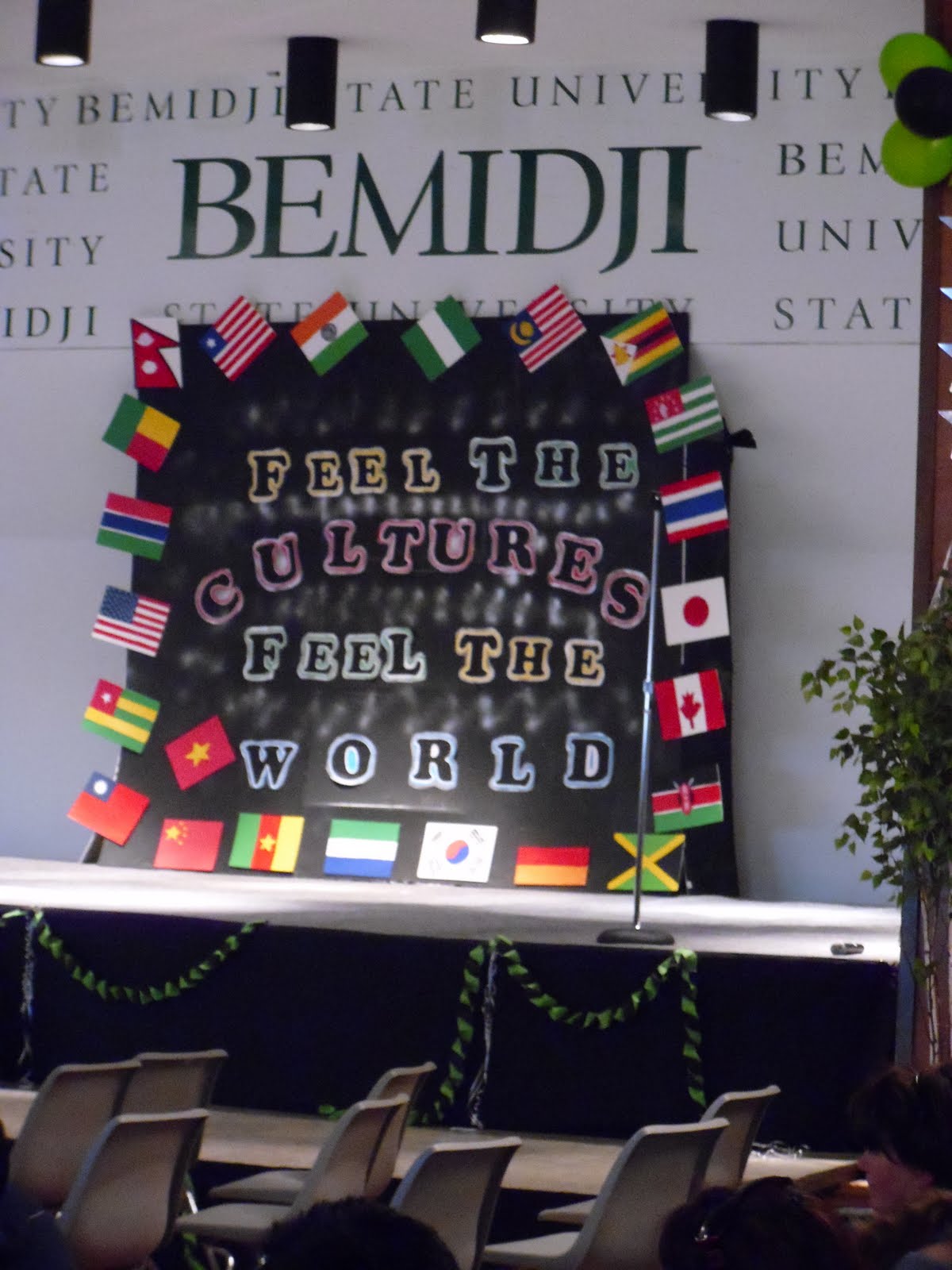
Kaneko was actively involved in the
Festival of Nations.  This year's theme was
"Feel the Cultures Feel the World"
Photo by David Teeples
Kaneko is from Gifu, Japan, a city located near the center of the island country.  She now studies accounting with a minor in German at Bemidji State University, over 8,000 miles away from home.  She found BSU online and said that the low tuition prices were largest factor in her decision to study in northern Minnesota.  Her interest for German began when she was in middle school.  She became a fan of the German soccer team and has been interested in the language and culture ever since. 

Learning a new language always has its challenges, but Kaneko faces some extra challenges most of her classmates do not.  “One of the most difficult things is first language interference,” explained Assistant Professor of German Lisa Graefe, “Another thing that can be difficult is finding the learning style of the student.”  Kaneko expresses similar challenges, “I have a lot of trouble with the spelling of [German] words.”

During the Festival of Nations Kaneko served Japanese food and wore a traditional Kimono.  She also helped served German food and helped create the German booth.  Thus she represented both Japan and Germany.  Kaneko also participated in the set up effort.  She worked on making Japanese food to serve at the festival and helped with the German Club poster by taking care of supplies and even providing snacks for the volunteers who contributed time to create the booth.  “Chikako adds some great energy to the German Club,” remarked German Club president Jordan Shearer.  

Kaneko finds learning about other cultures very exciting.
Photo by David Teeples
Festival of Nations, an annual event on the BSU campus, attracts students and community members of all ages.  This year they celebrated the 42nd anniversary of the event with the theme “Feel the Culture, Feel the World.”  Kaneko was elected to be the Treasurer for the event by fellow international students her at BSU.  As treasurer she was in charge of making sure every group serving food and setting up a booth received funds. 


 Kaneko feels the Festival of Nations is very important event on the BSU campus.  “It is a great chance for both international and American students to encounter a variety of cultures.” Kaneko explains, “When we only know our own way, we consider others to be wrong.”   She shows great passion for learning about different cultures, “It is fun to know different people in different cultures.” 

Sunday, February 20, 2011

Ever Wonder About What You Can Find at the A.C. Clark Library

Ever Wonder About What You Can Find at the A.C. Clark Library
A Look Inside of the Special Collections Library and University Archive
By Zach Swaser
The A.C. Clark Library at Bemidji State University offers a wide selection of materials and services for students and the public. Many do not realize how much information can be found at the library. One of the many overlooked departments in the library is the special collections library and university archives on the second floor. This is where one may find any information about the school and region surrounding Bemidji.
Upon entering, a small room is found filled with antiques, paintings, record players, one ugly composer’s chair, and lined with shelves of books. This room is the special collections room. Special collections is a sub-section of the library that contains primary information about the university along with rare and expensive books, 2nd copies, faculty publications, and a complete master thesis collection of past Bemidji State students.
The main difference between the information in the archive and special collections is primary and secondary information. According to Bill Shaman, the special collections librarian at the A.C. Clark Library, many people get confused about the difference between primary and secondary information. “Primary information is in the moment,” said Shaman, meaning that primary information is written as it is happening.
The University Archive is strictly secondary information about Bemidji State University. The room is less appealing then the aged feel of the special collections room, with plain white walls and filled with organized shelves. Shaman described it as “a room with boxes of material,” most of which is unpublished. “The interest in University history is minimal” shaman said, so the room is not used very often. When asked what he thought was the most interesting thing at the library, Shaman mentioned “candid photos” and “presidential papers.”
Along with information about the University the special collections and archives are home to regional newspaper collections and big name newspapers like the Chicago Tribune and the New York Times. You can find every issue of the Bemidji Pioneer starting from 1965, “the only complete collection” said Shaman. The archives also host all of the university’s sound recordings and media. It is amazing how it all fits into two rooms that are not much bigger than most bedrooms.
Some of the most interesting books in special collections would be the antiquarian collection, which dates back to about 100 years from Johannes Guttenberg. The collection sits menacingly in a locked black cabinet. Some of these books date back to the 16th century and are made from very thick paper. “They will last long after we are all dust.” said Shaman.
The antiquarian collection consists of many versions of the bible; Shaman’s favorite is the 400th anniversary First King James Bible. The book is ancient looking, black and beaten with missing straps. It was imprinted with the date 1611, but according to Shaman, who thinks of himself as a “minor biblical scholar” after spending ten years studying all of the editions of the English bible, the book cannot have been made before 1615 or after 1617. It is also rare because it is a “she” bible, meaning that in Ruth iii, 15 it reads “She went into the city,” instead of “He went into the city.”
Overall, there are many useful tools in the A.C. Clark Library. If you ever find yourself needing information about Bemidji State University or the many services at the library don’t be afraid to ask around for help. Particularly, if you require assistance finding information about Bemidji talk to Bill Shaman. He is not hard to mistake, he is well spoken, wears glasses on a string that adds to a look of sophistication, unusually mixed with the comfort of moccasins jeans. He can usually be found at the library while it is open.